
Integrating Disability in Township Architecture

Updated: Oct 4
What is architecture?

Photographed floor plans
In short, architecture is the art and science of shaping buildings around human needs and the way people interact with their surroundings. It is about creating spaces that are functional, sustainable and pleasing to the eye (Purohit, 2024). But how well does it serve people living with a disability, especially in our townships?
How often is disability designed into township homes?

A residential entrance with no ramp for wheelchair users
Rarely.
Township stands are small, which limits what can be built. Boundary and building regulations, combined with tight budgets, often work against people with disabilities, forcing them to struggle with their homes every day. Typical houses have narrow doors, steep steps and toilets that a wheelchair user cannot get into.
Many township homes were delivered through government programmes designed to house as many people as possible at the lowest cost. Neither these houses nor the middle-class homes built around them were designed with accessibility in mind.
The roots of the problem are historical, spatial, social and economic. Apartheid-era planning created segregated, overcrowded townships with little regard for accessibility, and much of that pattern remains.
A personal experience
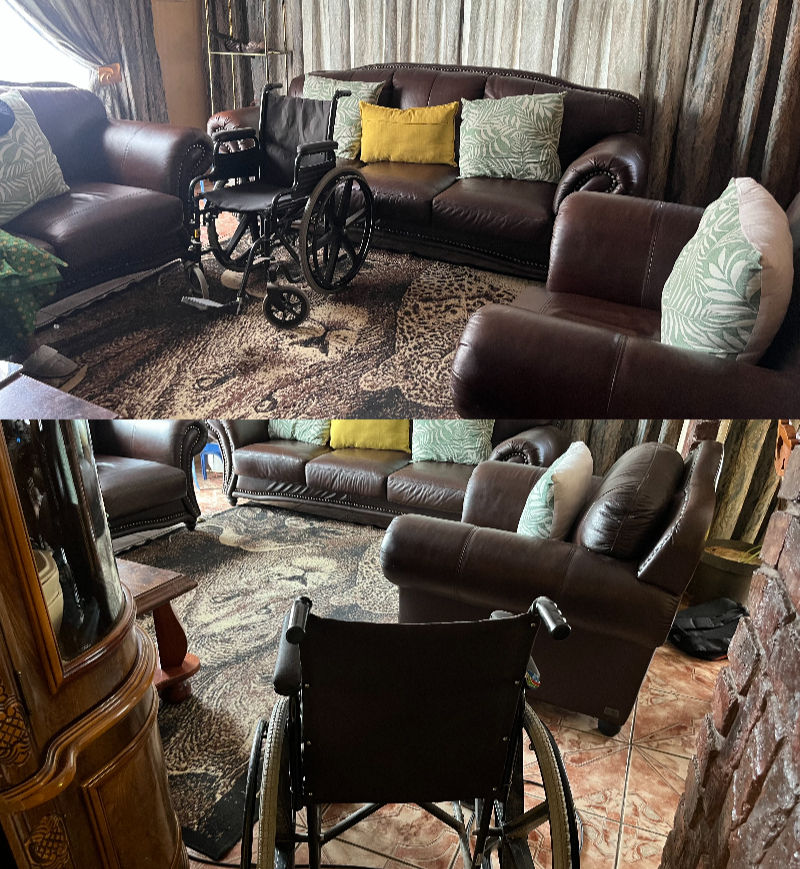
A lounge rearranged to allow wheelchair circulation
I grew up in a middle-class family in the township, and I have experienced first-hand what happens when a family member becomes disabled. We had to rearrange the living room so a wheelchair could move through it. We had to find a new way for them to bathe, because they could no longer get into the shower.
Moving a few walls would have helped, but we were limited by municipal regulations and by what we could afford. Ramps, wider doors and an accessible bathroom were out of reach. That is how socio-economic constraints turn into daily barriers.
Designing for accessibility

A minimal government-built home for low-income households
Architects can plan for the possibility of disability and old age from the start. The challenge is greatest in government housing, where houses are designed to strict boundaries and fixed budgets: small bedrooms, a kitchenette, a modest lounge and a compact toilet. Post-apartheid housing programmes repeated many of the old patterns, producing small, uniform units that do not accommodate people with limited mobility.
So what now?

Turning space in an existing bathroom for a wheelchair
Most township homes house large families, which makes space even tighter. High density, underfunding and informal building materials add to the problem.
The answer is intervention. Architects and government must work together on research-based designs that make small homes genuinely accessible, with level entrances, wider doors, roll-in showers and flexible rooms. In the next article, we will look at practical, affordable ways to do exactly that.
Need to make a home accessible?
TectArch Architects is an award-winning, PrArch-led practice based in Johannesburg. We design accessible homes and alterations, including ramps, wider doors and accessible bathrooms, that comply with SANS 10400-S and get council approval.
Book a Site Assessment to see what is possible in your home.
Written by Kekeletso Motsieloa, Candidate Architectural Technologist, TectArch Architects.


Comments